Kiitos paljon!
Reflections on Visiting Tampere University of Applied Sciences (TAMK)
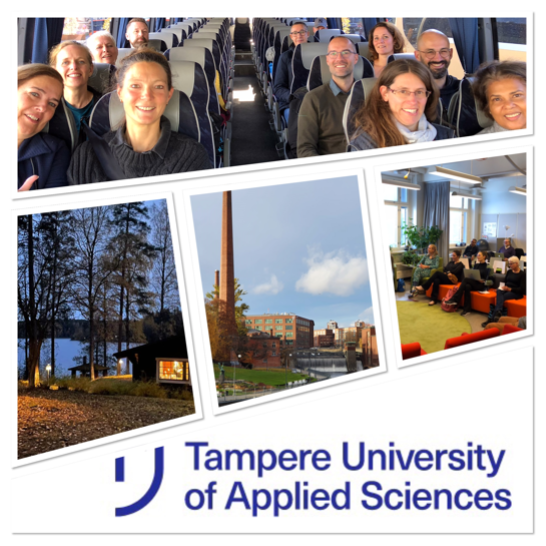
Tampere was the homebase for this week’s transnational Erasmus KA2 project meeting: ‘Mitigating Covid Together’. Susanna Saarinen, Eija Syrjamaki and Jussi Hannunen hosted a wonderful project meeting full of presentations, reflections, and discussions. The Faculty of Social Work and Education of The Hague University of Applied Sciences (THUAS) had the privilege to attend this project meeting with twelve very enthusiastic lecturers of the social work, pedagogy, and teacher education programmes as well as one colleague of the support staff.
Together with colleagues of Palacky University and the University of Hradec Kralove, Czech Republic, we arrived on Wednesday afternoon and reunited that evening over a nice dinner in a beautiful ambiance. It was great to see each other again. The actual project meeting started on Thursday morning. All colleagues were very impressed by Suvi Hagström’s and Tarja Heinonen’s presentation of the Virtual Lab for Social and Health Care. In this so-called living lab, academics, students, and private companies collaborate on innovative applications of technology in social care as well as in health care/ medicine. We envied the Finnish colleagues for the amount of high-tech equipment they have as well of their expertise to apply this equipment in professional practises, but also for their approach regarding the awareness for wellbeing, something we all recognized.
After the Virtual Lab, our tour continued to the learning environment: HyPedLab, the pedagogical hybrid space, in which educational technology applications was shown. Teija Lehto introduced us to the world of hybrid teaching and learning as there is a demand for knowledge on this way of learning and instruction after the Covid-19 pandemic. There is also a need within TAMK for professional teacher education and hands-on training facilities for teacher students. Teija showed us the well-equipped classroom in which – among others – data projectors project information at the walls, a (digital) owl sees, hears and broadcasts everything that happens in the classroom, and students can work in flexible groups. Having such a state-of-the-art classroom is something I dream off, but the presentation made us aware of the fact that working from such a rich learning environment asks for different ways of teaching than teaching in a traditional/ physical classroom. Therefor professional development of university lecturers is needed as well.
Henri Annala and Miina Kivelä showed us in the next session that it can be very helpful to have ‘digimentors’ in your team. Digimentors are early adaptors of teaching and learning technology that are facilitated timewise to assist their colleagues to develop and/ or innovate education. TAMK colleagues can ask their colleagues for help. As these colleagues have designated hours, asking colleagues don’t have to be hesitant asking their colleagues for support. Moreover, the digimentors are very much willing to share their expertise in order to improve the education provided by their own faculty or programme.
A fourth session took place after lunch. In this session, Sanna Sintonen and Mervi Mustonen informed us about the advanced software, called EXAM. This electronic exam software for higher education is a software programme developed by an independent company for 28 Finish institutions of higher education. What is maybe even more special than the software itself is the way it is used. Students of the 28 institutions of higher education can do their digital exams within a timeslot of three weeks (Monday till Saturday, including evenings) at one of the 28 institutions. So, students choose when and where they make their exams. EXAM scrambles questions from a database with questions, with the result that every student gets a unique exam. As there are many places where students can make their exams as well as many timeslots, the participating universities don’t have problems with test facilities. By the way: during the tests/ exams, students are (video) recorded. All recordings are analysed for “cheating”. Interesting to hear was that taking exams at home via proctoring is not allowed in Finland due to privacy reasons.
In the late afternoon, the THUAS colleagues of the social work programme had the opportunity to meet with a colleague of TAMK’s social services programme, Eeva-Mari Miettinen. The pedagogy and teacher education colleagues met Henri Anala and Juha Lahtinen of the teacher education programme. In this timeslot, the project team recorded to videos for the website www.goingvirtual.euat the same time. These videos can be viewed soon. All three sessions were very productive and lead hopefully to further cooperation between our four universities.
The absolute highlight of this two-day meeting was a traditional sauna visit on Thursday evening. Although going to a sauna might be a common thing to do in Finland, some Czech and Dutch people had to overcome their trepidation to take part in the sauna session. Maybe even more challenging than going in the sauna was the cooling off in the icy lake that was located next to the sauna cabin. Prior to this challenge, our hosts offered us a delicious and copious dinner.
Friday was the last day of our transnational project meeting. The morning of this second day was all about Proakatemia. Proakatemia is a programme, or two years of a programme on entrepreneurship and team leadership. In this programme students work together with coaches on assignments they get from “real” companies. In Proakatemia, students are entrepreneurs from day one and are also treated as such. Thinking of Dutch higher education, I had to think of the concept of ‘Probleem Gestuurd Onderwijs’ [Problem Based Education]. A problem is in this case not something problematic, but an actual professional task that needs to be fulfilled, or a product that has to be designed, produced and marketed. Proakatemia doesn’t work with a fixed curriculum. The curriculum arises from questions that companies put to students. The same applies to assessment. One of the criteria for marking students is the success they have with their business. Moreover, it’s not just the academics that mark students, peer assessment is also part of the final marking. As students in Proakatemia develop a broad academic base comparable to liberal arts and sciences programmes, all kinds of students enter this programme. So, not only business students, or social sciences students. All colleagues (Czech and Dutch) were impressed by the educational approach. The Dutch colleagues are thinking of possibilities to implement this approach for a faculty-wide minor in which social work, pedagogy and teacher education students collaborate with business students on entrepreneurship and team leadership.
The project team had its project meeting after a(nother) delicious lunch. The ‘Mitigating Covid Together’ project will come to an end in 4 months’ time. So-called ‘intellectual outputs’ have to be delivered and a final symposium will take place at Palacky University in Olomouc, Czech Republic. One of the nice things of this coming symposium is that not only academics will be involved, but students as well! I look forward to visiting Palacky University! However, I like to end this reflection with showing my great appreciation to Susanna, Eija, and Jussi. They organised a fantastic project meeting with highly interesting content and made us feel more than welcome in Tampere. Kiitos paljon! Thank you very much!
Michel Hogenes
Helsinki, October 15, 2022
Meer Muziek op de Pabo
In het Onderwijsblad van de AOb dat onlangs verscheen stond een mooi interview met de in 1970 aan de KLOS afgestudeerde leerkracht Pieti Donkers-Boon. In dit interview doet zij een oproep om kleuters meer te laten spelen, iets waar geen jonge kind-specialist tegen zal zijn. In hetzelfde artikel stelt zij echter ook dat er op de pabo’s geen muziek meer wordt gegeven. Dit is niet helemaal juist.
De huidige pabo heeft een heel andere opzet dan de KLOS, de Kleuter Leidster Opleiding School, die in 1984 samen met de Pedagogische Academie opging in de pabo. Studenten worden tegenwoordig niet meer alleen voor het lesgeven aan kleuters of 6 tot 12-jarigen opgeleid. Zij krijgen een brede bevoegdheid waarbij ze ook geschoold worden in het geven van muziek.
Muziek maakt samen met beeldende vorming, dans en drama deel uit van het domein Kunstzinnige oriëntatie en wordt als vak op alle pabo’s in ons land aangeboden. Studenten leren hoe ze met kinderen kunnen zingen, luisteren, spelen, componeren & improviseren, lezen & noteren, en bewegen. Wat het geven van muzieklessen lastig maakt is leerkrachten vaardig en zelfs wendbaar moeten zijn in al deze gebieden.
De afgelopen jaren heeft het basisonderwijs de mogelijkheid gehad om gebruik te maken van de door het Fonds voor Cultuurparticipatie ingestelde impulsregeling Muziek. In navolging daarvan hebben ook alle pabo’s in ons land gebruik gemaakt van een vergelijkbare regeling. Hierdoor is de samenwerking tussen pabo’s en conservatoria versterkt, hebben veel pabo’s extra lessen kunnen verzorgen en zijn de mogelijkheden voor nascholing uitgebreid. Daarnaast zijn er pabo’s die de subsidie hebben aangewend om muziek in samenhang met andere vak en vormingsgebieden aan te kunnen bieden. Er is heel veel gebeurd en nog steeds veel gaande.
Alle kinderen hebben het recht hun muzikale talenten te ontdekken en te ontwikkelen. Hiervoor hebben ze leerkrachten, vakspecialisten muziek en vakleerkrachten nodig die deze talenten herkennen en erkennen. Deze onderwijsprofessionals moeten instaat zijn om muzieklessen te verzorgen die aansluiten bij de ontwikkelingsbehoefte van de kinderen die zij in de klas hebben. Pabo’s en conservatoria doen er alles aan om samen met organisaties als Gehrels Muziekeducatie en Meer Muziek in de Klas het vak muziek in de basisschool verder te versterken. We zijn er nog niet, er kan zeker nog een tandje bij, maar we zijn zeker op de goede weg.
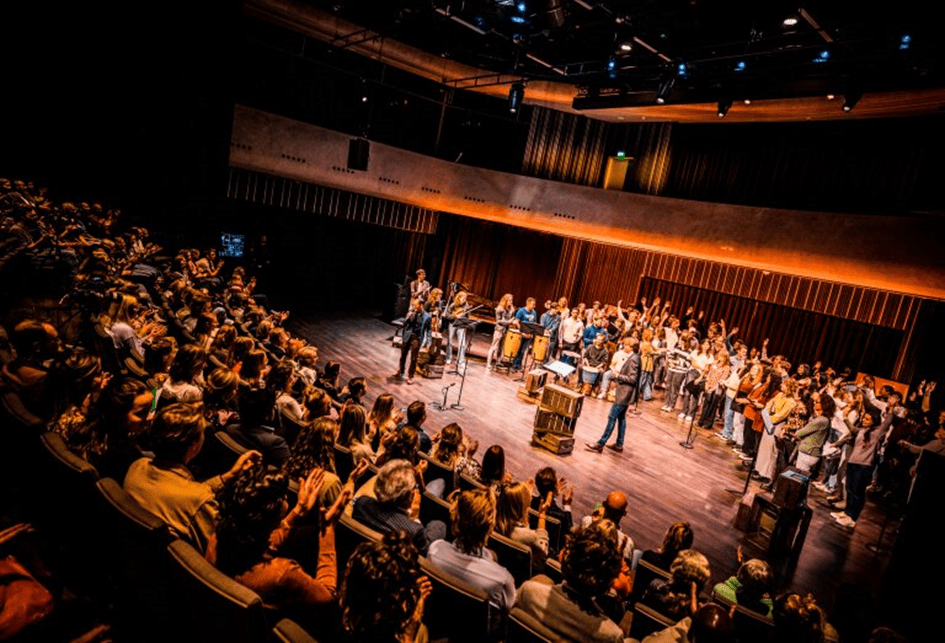
Foto: Koor van pabo- en conservatoriumstudenten, pabo De Haagse Hogeschool en de opleiding Docent Muziek Koninklijk Conservatorium, Amare, 5 oktober 2022, MuziekOpleidersAkkoord, Meer Muziek in de Klas.
Foto: Set Vexy.
March 26, 2023
 Michel Hogenes